
Local areas across the UK will be helped to boost their digital connectivity and adopt advanced wireless technologies, including drones to monitor crops and livestock, smart systems to reduce congestion, and portable 5G networks to enable super-fast live broadcast from remote locations.
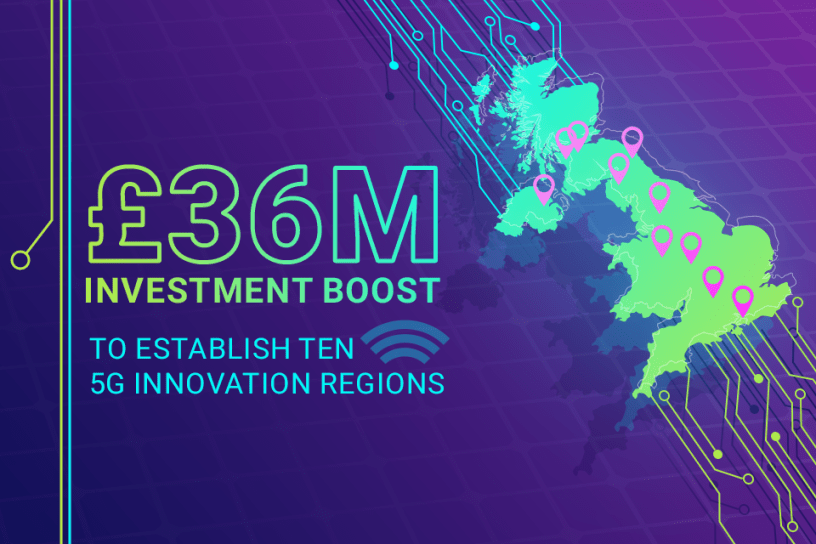
Announced today (16 November), ten winning multi-local authority areas spanning all four parts of the UK will receive a share of £36 million as they become 5G Innovation Regions. The funding will drive the development and adoption of 5G and other advanced wireless technologies – making sure communities in towns, cities and rural areas take full advantage of the benefits advanced wireless connectivity and digital technologies can provide and attract commercial investment to grow the economy.
Amongst those set to benefit is Glasgow City Region who will receive over £3 million to deliver a health and social care focused project that will use advanced wireless technology, such as the Internet of Things (IoT) and smart city applications, to make public services better. The project will specifically focus on monitoring and maintaining assets, creating environmentally friendly social housing, and improving the monitoring of health and social care services.
Greater Manchester Combined Authority will receive over £3 million, part of which will be used to 5G-enable hundreds of air source heat pumps across social housing in the region. By using 5G the UK will accelerate the creation of Smart Energy Grids and bring forward benefits for residents, industry and public services by allowing them to better monitor energy use and save money on their bills.
The project will connect hundreds of existing air source heat pumps across Greater Manchester’s social housing settings using 5G technology, accelerating the creation of Smart Energy Grids.
A smart energy grid, is an advanced electrical grid system that uses information connectivity and tech to efficiently manage local generation, distribution, and use of electricity, aiming to modernise traditional infrastructure, making it more efficient and adaptive to meet the needs of our people and businesses.
These grids will deliver benefits for residents, industry and public services, aligning with Greater Manchester’s Local Area Energy Plan, helping to reduce costs for residents and housing providers while cutting harmful emissions.
Co-located on the same 5G network, a Digital Roads network environment will be piloted, aiming to reduce congestion and carbon emissions and prioritise traffic flow such as public transport in a quicker, more efficient way, reducing the amount of stationary traffic.
A key commitment from the Government’s Wireless Infrastructure Strategy, the 5G Innovation Regions programme is designed to boost innovation in sectors such as advanced manufacturing, transport, agriculture, creative industries, and public services, helping to create better connected places across the UK. These projects will stimulate demand for 5G connectivity, bringing the government’s vision of unlocking the power of cutting-edge 5G wireless and digital technologies to life, with research showing widespread adoption could result in productivity benefits of £159 billion by 2035.
Today’s announcement comes as a new advisory group with representatives from all four parts of the UK is launched. The board will support local areas to put recommendations to government on how to support their digital connectivity goals, encourage investment, and promote adoption at a local level.
Minister of Data and Digital Infrastructure Sir John Whittingdale said:
“We’re channelling millions into local areas to unlock the potential of cutting-edge 5G wireless and digital technologies which will reshape our public services, drive economic growth and boost innovation. This new fund will give local areas from across the country the opportunity to be at the forefront of Britain’s world-leading 5G revolution.
“For instance, by using 5G for farming and creating science parks, we’re not just helping local communities, but also encouraging new ideas all over the UK. This is more than just linking smartphones. It’s about using powerful digital connections to transform various sectors in the economy and the public sector throughout the entire country.”
Discover more from
Subscribe to get the latest posts sent to your email.
 news4trafford.co.uk