

Despite the Prime Minister and Health Secretary hailing the fall in figures last week, hidden evidence in official data reveals the government’s target to cut NHS waiting times may not have actually been met
The majority (53%) of Manchester NHS Trust patients are waiting more than 18 weeks for treatment – the fifth highest figure out of any UK trust.
A new investigation by Medical Negligence Assist has revealed that there are 11 NHS Trusts where more than 50% of patients are waiting more than 18 weeks for treatment.
Last week, Prime Minister Rishi Sunak and Health Secretary Victoria Atkins hailed the fall in the number of people waiting for treatment. However, a change in the way the data was presented could mean figures have actually increased.
What’s more, a new investigation by Medical Negligence Assist has revealed that only three out of 136 NHS Trusts came close to meeting the referral-to-treatment waiting times target set out in the NHS constitution.
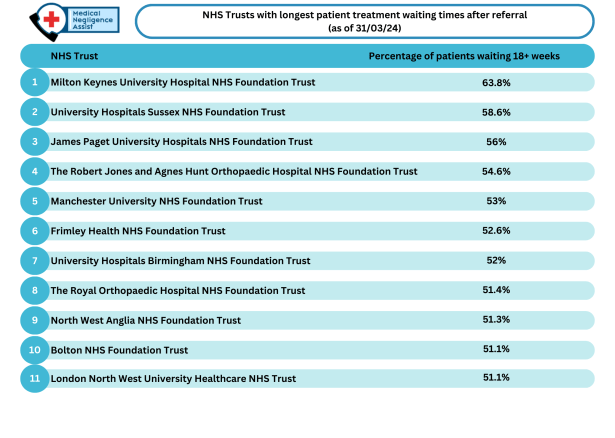
Manchester Trust was found to have 53% of its patients waiting longer than 18 weeks from referral to treatment.
The NHS constitution states that patients should wait no longer than 18 weeks from GP referral to treatment but waiting times in England have been ‘stubbornly high’ for some time.
Through an in-depth analysis of the latest NHS England Data, Medical Negligence Assist has uncovered the NHS Trusts with the longest waiting times as well as those where figures look to be improving.
Manchester University NHS Foundation Trust was revealed as having the fifth-highest percentage of patients waiting more than four months for treatment after being referred.
53% of patients referred to treatment have been waiting longer than 18 weeks as of March 2024 – a total of 187,109 people.
Moreover, the majority of patients within Manchester NHS Trust (92%) were waiting 51 weeks or less for their treatment.
Only trusts with a percentage of 50 or above have been included in results with the longest patient referral-to-treatment waiting times.
Just three out 136 NHS Trusts came close to meeting the NHS waiting time target of 18 weeks and all were cancer-focused centres.
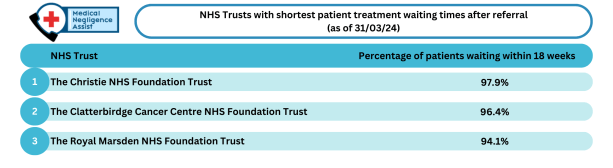
The Christie NHS Foundation Trust in Withington, Manchester had the shortest recorded waiting time for patients who had been referred for treatment with 97.9% seen within 18 weeks.
Further data shows that the majority (92%) of patients were treated within 12 weeks of being referred – the shortest waiting time out of all UK NHS Trusts.
Second on the list is The Clatterbridge Cancer Centre NHS Foundation Trust in Merseyside where 96.4% of patients were waiting within the NHS target of 18 weeks.
The majority of its patients (92%) were seen within 14 weeks.
Lastly, The Royal Marsden NHS Foundation Trust in London saw 94.1% of patients who had been referred to treatment, waiting within 18 weeks. Most patients (92%) were treated within 16 weeks.
Only trusts with a percentage of 90 or above have been included in results. The percentage of patients waiting within 18 weeks then plummets from 94.1% to 83.1% at the Royal Berkshire NHS Foundation- where the majority of patients are treated after being referred within 24 weeks.
It comes as the chief analyst at a health and social care charity, says the government must prioritise investment in preventative services to keep people out of hospitals as well as putting money into crumbling NHS buildings in order to combat the deterioration in NHS performance.
Siva Anandacina, of The King’s Trust, says: “The hospital waiting list remains stubbornly high at 7.5 million in March, representing 6.3 million people waiting, often in pain or unable to work, for treatment.
“A&E departments also continue to be under extreme strain as we head towards summer, with over 2.2 million attendances in April, and only 74% of people being seen within four hours.
“It has been nearly a decade since A&E performance targets were reliably met, and there is little prospect of performance substantially improving in the near future.
He adds: “It is patients and staff who are bearing the brunt of the deterioration in NHS performance over the past ten years.
“Successive governments have failed to invest in services to keep people well and outside of hospital. At the same time, NHS buildings and equipment have been allowed to degrade and become dilapidated.
“The government will need to prioritise both these areas if it wants patients to receive the urgent and emergency care they truly need.”
As of March 2024, an estimated 7.54 million treatments were waiting to be carried out in England, relating to 6.29 million patients.
The latest official figures from NHS England show a drop of 916 waits from the previous month.
However, the caveat to the new data shows that 7,000 people were transferred from the referral-to-treatment data list to waiting lists for community services such as community paediatrics.
Separate waiting lists for community paediatrics, which covers issues such as special needs and child development, show that figures have been increasing since January.
If those numbers had not been removed, the main official NHS waiting list would have actually risen by more than 6,000 – which would mark the first monthly rise in six months.
Health and Social Care Secretary, Victoria Atkins last week said: “NHS staff are working tirelessly to cut the waiting list and recent data shows the biggest six-month reduction in over 10 years outside of the pandemic.
“This is a significant achievement in the context of record pressures and strikes, with NHS analysis showing the list could have fallen by an extra 430,000 since December 2022 without industrial action.”
If treatment for health conditions, injuries or illnesses has fallen below the expected standard of care, medical negligence may be at play.
Head of Medical Negligence at Medical Negligence Assist Nick Banks said: “Whilst claiming against the NHS can seem daunting, such claims are the best way to ensure funding is made available for all of the patient’s short-term and longer-term needs.
“This can make a real difference to how quickly that patient is able to regain their former quality of life.
“Bringing such claims can also help the medical profession to identify important areas of improvement, hopefully ensuring that no future patients ever fall victim to the same mistakes.”
Medical Negligence Assist has a team of experts at hand to offer professional advice for anyone who has suffered medical negligence.
They operate a 24-hour helpline and live chat service which you can access on their website.
Discover more from
Subscribe to get the latest posts sent to your email.
 news4trafford.co.uk