
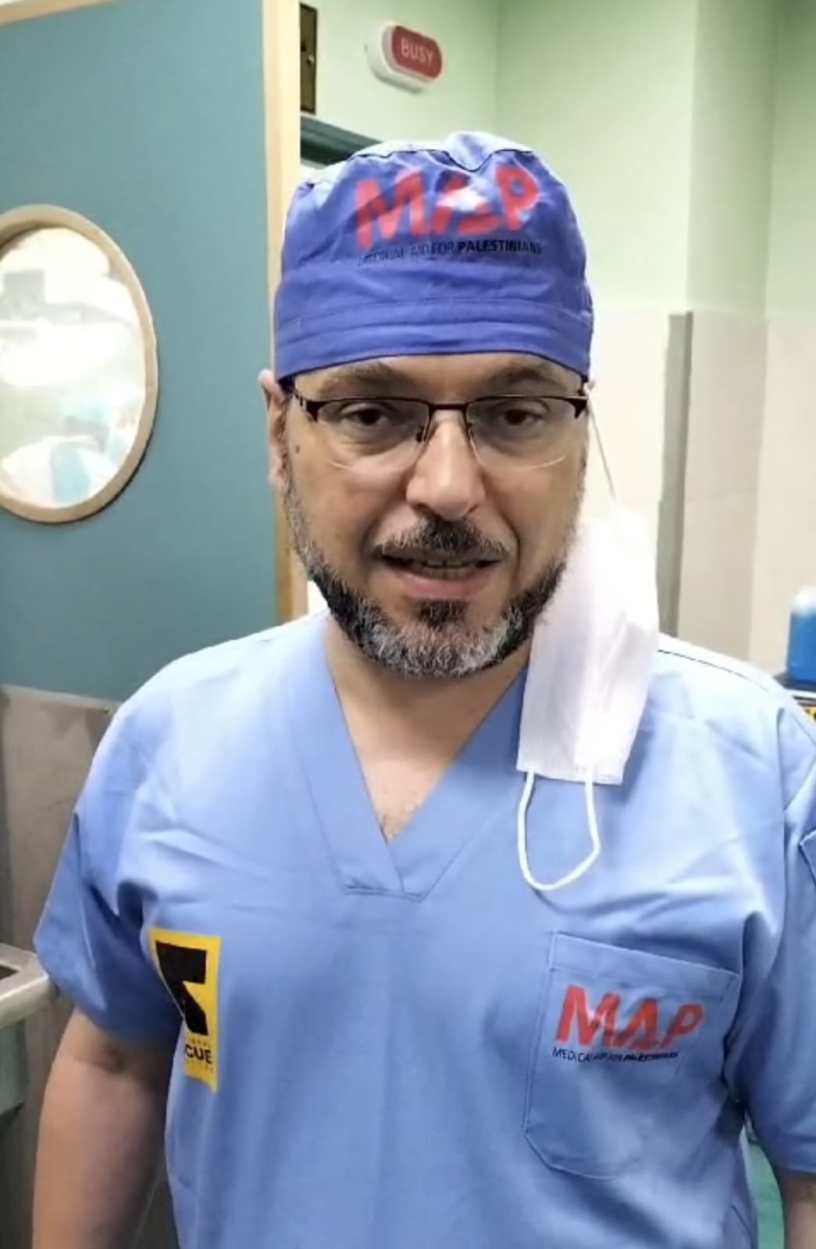
Dr Ammar Darwish, is a general and major trauma surgeon in Manchester and clinical director for the David Nott Foundation.
He lives in Manchester with his wife and two children. He has recently returned from a month of volunteering in Nasser Hospital in Gaza with Medical Aid for Palestinians (MAP) and the International Rescue Committee (IRC). He has been working in conflict zones for over 15 years. He said:
“This was my second recent mission to Gaza – the first was in January. It felt important to go. I’d seen the amount of mass casualties on the news, and the huge need for doctors there, the lack of medical personnel, lack of medical supplies. It’s a duty to help and support those on the ground.
“I’ve been to Syria many times, especially Aleppo, which of course is demanding in terms of emergencies and casualties. But Gaza is on another level because of the severity of the injuries and the number of casualties constantly coming through, as well as the lack of facilities, lack of even the basic essentials.
“Secondly, there are no safe areas for the patient to be referred to. If you have a severe injury, all you can do is treat them with the limited resources you have. So, it was a stressful few weeks, but this is what the local staff have been dealing with for the last year or so.
“Patients die unnecessarily. Of course, no patient should die, but they are often dying of preventable complications of injuries. They are lives which could be saved if we had basic medicine and equipment.
“These people are individuals. They are men, women, children. Fathers, brothers, mothers, wives, sisters, daughters. So many children. You see the agony and the pain in both the patients and their families but what affects me the most, I think for all the team, are the injured children.
“One patient was a four-year-old girl who had a direct bullet to her head that hit the brain, her mother and father were absolutely devastated. We took her to theatre and operated, we didn’t think she’d survive, but she did. She has neurological deficits and will need rehab and further surgery, and that is simply not available in Gaza. Along with many other children similarly afflicted.
“But the problem is not just the physical injuries. There’s also the huge mental and psychological trauma that these children and adults go through which will scar them for life, likely leading to decades of intergenerational trauma. This is a huge problem that the medical profession and local families will be facing for years.
“As international medical teams we focus on our patients and do our best to save lives. We have a lot of support from our local colleagues as well as those in the UK. I’m also lucky to have the support of my wonderful family, my wife and my kids. My faith also gives me extra strength to continue doing this work.
“My family worry about me going out to conflict zones of course, from the day I leave until the day I come back. They’re always trying to message me, to get through to me, see how I’m doing and ask if I’m OK. But they totally understand and are really supportive, so I’m really grateful for that.
“Among the injuries we dealt with are quadcopter injuries which were often severe and even fatal.
“The hospital has shortages of everything, IVs, medicines, consumables, antibiotics. At one stage we were operating without even surgical gowns – a sterile gown is an absolute basic. Without surgical gauze, we’d have nothing to use to stop the bleeding.
“The Palestinian staff are amazing – they have been working in this context for a year now, and they themselves have been displaced from their homes too, and their families have been displaced multiple times.
“They’re worrying about their families and they know they can be shelled or bombed at any time. There are evacuation orders every day.
“We’d get mass casualties two or three times in 24 hours. For comparison, working at the trauma centre in Manchester, we have a mass casualties’ incident two or three times a year. In Gaza, you see it every day and the exhausted staff are dealing with it with very limited resources. And people die because of that.
“I will be going back to Gaza because there is huge need, which will continue for years to come, not just when the war stops. I’ve worked in Syria and Ukraine multiple times which are really hot war zones, but it doesn’t compare to Gaza. It’s definitely worse.
“Irrespective of what side of the politics you stand, an immediate ceasefire is absolutely vital. Without it the deprivation, the mental trauma, the disease, the malnutrition, the huge number of children who are losing limbs daily will continue to rise.
“MAP is really good at organizing and looking after the emergency medical teams. I’ve worked with them twice now and looking forward to working with them again.
‘”MAP and IRC take all efforts possible to make it as safe as possible for us as international medical teams. We don’t leave the hospital. In theory it is deconflicted. But when I was in Gaza in January, we stayed at a guesthouse which was deconflicted, in a safe zone, but the house was still targeted with a bomb while we were in it. We escaped with some minor injuries, but no place is truly safe. Yes, it is risky for medical teams, but it has to be done. I feel it is worth it, if we can save lives.”
Discover more from
Subscribe to get the latest posts sent to your email.
 news4trafford.co.uk