
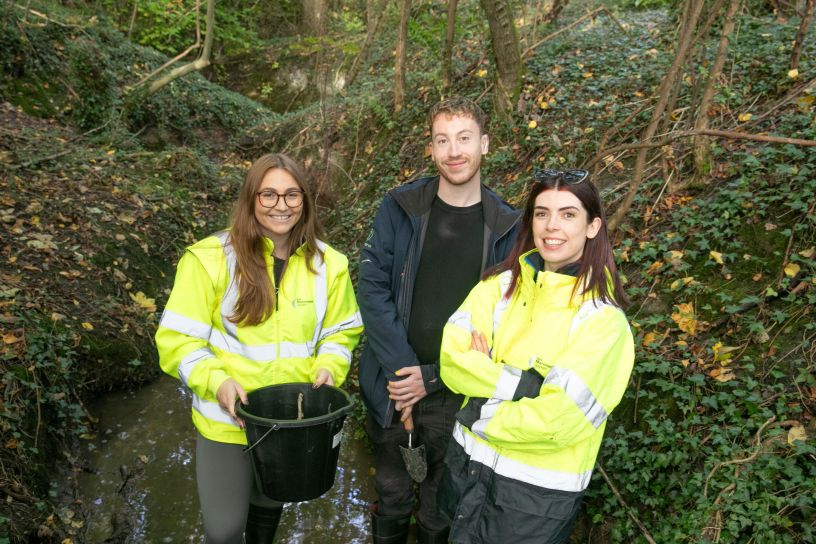
Manchester Airport has teamed up with a leading conservation specialist to use rare plants that flourish near the airfield to boost ecosystems around the region.
Cotteril Clough, the city of Manchester’s only Site of Special Scientific Interest, sits partly on the airport’s land. Its proximity to the airfield means it has been protected from human interference for many years and is home to a rare combination of ancient plants.
Species like bluebells, wild garlic and wood anemones used to coexist in ancient woodlands all over the country. Now they are treated as ‘indicator species’ – meaning their presence is an indicator of a healthy ecosystem.
These species and others all exist in Cotterill Clough and now the airport’s environmental team, in conjunction with Styles Ecology, is helping spread these species into nearby woodlands and wild spaces to support their biodiversity.
Among the team working on the scheme is award-winning ecologist, Josh Styles, who founded the North West Rare Plant Initiative in 2017 and has appeared as an expert on BBC Countryfile.
The project began in June this year with selected plants and seeds transferred from the Cotteril Clough site – closed to the public to protect its delicate ecosystem – to other nearby locations.
Hundreds of plants and seeds have now been transferred, in conjunction with Styles Ecology and in consultation with Natural England.
The process will not have any impact on the ancient woodland, as the small gaps left from individually lifting the plants will naturally fill in over time, but the scheme will speed up the dispersal of these key species into woodlands in other areas of Greater Manchester and Cheshire, many of which have been degraded by human intervention and have lost the rich variety of species that they would otherwise host.
Isabella McQuillan – Biodiversity Infrastructure Manager, Manchester Airport said:
“A key interest of mine is fostering resilient and healthy ecosystems, so it was fulfilling to complete this project, knowing we’ve directly contributed to improving local biodiversity and facilitating a wider and faster spread of these important woodland plants.
“The inspiration for this project came from a training day Josh led earlier this year with airport colleagues. Upon learning about the slow dispersal of ancient woodland species and its impact on the health of these important habitats, we were determined to play our part in addressing that issue
“it’s a privilege to have one of this region’s only woodland Sites of Special Scientific Interest on our land and we take our environmental responsibilities very seriously.”
Discover more from
Subscribe to get the latest posts sent to your email.
 news4trafford.co.uk