
Rising levels of poverty, unemployment and a lack of affordable housing have led to the number of rough sleepers increasing in the UK.
More than 2,000 counts of rough sleeping were logged by the council in Manchester over the past four years, a new investigation has revealed.
Figures obtained by Advice.co.uk found that Manchester City Council has logged 2,343 counts of rough sleeping in the area since 2021.
Rough sleeping is one of the most visible types of homelessness as it includes sleeping outside or in places that aren’t designed for people to live in, including cars, doorways and abandoned buildings.
Many rough sleepers are vulnerable and struggle with complex physical and mental issues such as addiction.
In 2018, the average age of a rough sleeper at death was just 44 years old for men and 42 years old for women.
When support structures that prevent rough sleeping, like emergency accommodation, are unavailable, people can be forced to the streets. Once someone is forced into homelessness, these problems can become more difficult to resolve.
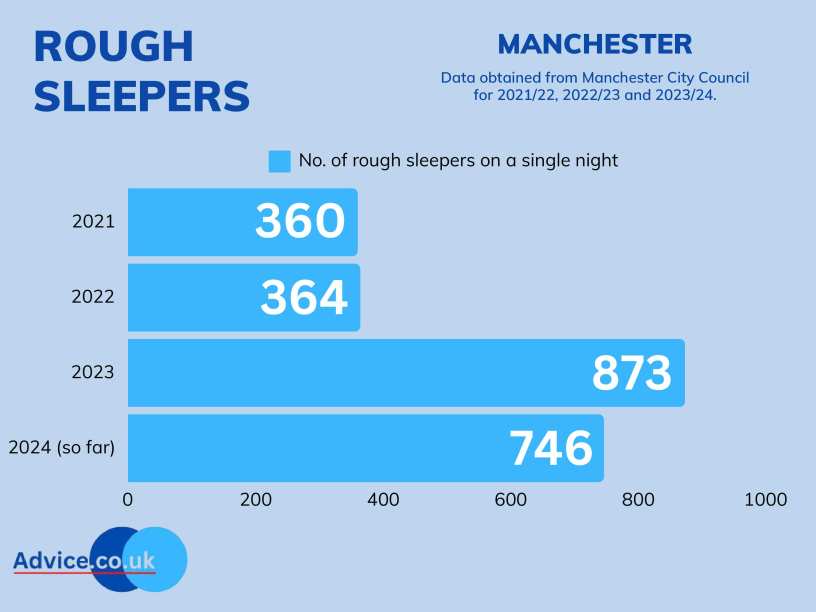
In 2021, the number of rough sleeping counts logged by Manchester City Council stood at 360.
A year later, this number slightly increased, with the total being 364.
2023 saw a huge leap in rough sleeping counts, reaching 873.
So far in 2024, the council has logged 746 counts of rough sleeping with this number expected to increase in December.
These figures refer to people who have been verified as rough sleeping by the Council’s Rough Sleeping Support Service at any point throughout the calendar year.
Due to the rising cost of rent as well as the cost of living crisis pushing more people to seek help, councils are struggling to find and fund temporary accommodation.
Riverside, a charity providing hostel accommodation, said there had been no significant investment in hostels in England since 2011, and the number of bed spaces in England had fallen by almost a quarter between 2010 and 2022.
Speaking to the Big Issue, John Glenton, the executive director of Riverside, said: “Increased investment in supported housing would provide more spaces to help get more people out of temporary accommodation into a dedicated space where they can receive the support they need.
“These services provide a route out of homelessness and help to reduce spending on very expensive, and often inadequate, temporary housing.”
The latest government statistics show 358,370 households contacted their local authority for support after being threatened with homelessness or losing their home in 2023-24, up more than 10% in a year. Of these, 324,990 were assessed as homeless.
Additionally, 3,898 people were sleeping rough on a single night in Autumn 2023, this was up more than a quarter on the 3,069 people counted in 2022 and is more than double the 1,768 people on the streets in 2010.
Homelessness charities called the figures ‘shameful’ and urged the Labour government to ‘act to put an end to rough sleeping
Discover more from
Subscribe to get the latest posts sent to your email.
 news4trafford.co.uk