
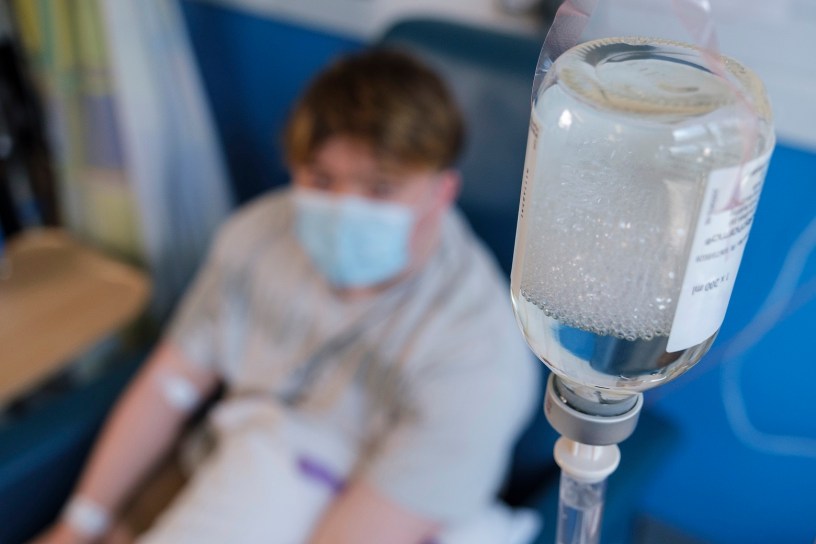
NHS patients around the country are now receiving a lifesaving medicine made from the plasma of blood donors in Manchester.
This historic milestone marks the first time in a quarter of a century plasma is being used to make life-saving medicines for NHS patients, reducing reliance on imports.
These lifesaving medicines can only be made from human blood. Plasma makes up 55 per cent of our blood and contains antibodies which strengthen or stabilise the immune system.
The antibodies are separated out and made into medicines which treat people with life limiting illnesses such as immune deficiencies.
Over the past three years, plasma from blood donors in Manchester and across England has been stored up, and it has now been made into medicines through a weeks long manufacturing process. The first patients are now receiving the medicines.
The most important medicine is immunoglobulin. In Greater Manchester and Salford, more than 1,000 people receive immunoglobulin each year. In the last reported year, 214 patients received immunoglobulin at Manchester University NHS Foundation Trust and 380 patients received it at Salford Royal NHS Foundation Trust.
Over the past three years, blood donors in Manchester have supplied around 23,200 litres of plasma, enough to make around 10,500 bottles of immunoglobulin, which is enough to save or improve around 300 lives a year.
In England, around 17,000 people rely on immunoglobulin to save or improve their lives each year. And thousands of patients rely on albumin – another plasma medicine – which is used in childbirth, trauma, and to treat liver conditions.
The news is important because there is a global shortage of plasma medicines. The NHS has previously relied solely on imported plasma medicines as a lasting legacy of Variant Creutzfeldt–Jakob disease.
The new supply of UK plasma medicines will bolster supplies to the NHS. It will reduce reliance on imports, which can be hit by reductions in supply and prices spikes.
There are two ways that you can give plasma. Every time you give blood in Manchester, your plasma may be used too. Or you can donate plasma at three specialist sites in Birmingham, London and Reading.
A recovered plasma donation gives us around 270 millilitres of plasma, whereas a plasma donation can give us between 560 millilitres and 700 millilitres.
Danielle Morley, aged 40, of Radcliffe in Greater Manchester, welcomed the news. Plasma medicine enabled her to have a family after she developed a blood disorder.
Danielle had immune thrombocytopenic purpura – her immune system was destroyed her platelets, the cell fragments which help blood to clot.
“I know firsthand how important these medicine help save lives,” said Danielle.
“It’s a relief to know we’re now making it from local blood donations too.
“I am so grateful to everyone who donates blood.
“You are not just helping people with your red blood cells – now the plasma in your blood donation is helping people too.”
Danielle, a youth mentor, trainee psychotherapist, and mum of three, was diagnosed with the illness during her first pregnancy by a routine blood test.
ITP can develop after a virus, vaccination or certain medications, but for most people the cause is unknown.
Common symptoms include are petechiae (pin prick rash of blood spots), bruising, nosebleeds, gum bleeds and black mouth blisters.
Danielle received intravenous immunoglobulin every three weeks during each pregnancy, which helped calm down her body’s immune response, enabling her to safely carry through to birth. She has also received IVIG on several other occasions when the illness has flared up outside of pregnancy.
Danielle said: “When I was first diagnosed during my first pregnancy, they said my platelets would continue to drop to a very low level and risks is internal bleeding which can ultimately be life threatening.
“This is why supporting donation for plasma is such a big thing for me. The only reason I was able to continue having children is they knew the IVIG worked for me and it would boost my platelets straight away.
“I just wouldn’t have all my children without immunoglobulin. I knew it was there and that it worked for me, which meant I could confidently have three children. I know I am incredibly lucky because it doesn’t work for some people.”
She added: “The people who donate are very selfless. They are going to help people. It’s really wonderful that donors come forwards.”
Daniel Cooper, NHSBT Assistant Director for Blood Donation Operations, said: “Thanks to our amazing blood and plasma donors in Manchester and across England, for the first time in a quarter of a century, patients are now receiving plasma medicines made from donations taken in England.
“We need more blood donors to help make more of these medicines and build UK self-sufficiency. Your donation is now helping save lives in new ways. Go to blood.co.uk to become a donor.”
Dr Susan Walsh, the Chief Executive Officer of Immunodeficiency UK, said: “This is a historic moment – patients from Manchester can now get lifesaving and life-improving immunoglobulin medicine made from the plasma of UK blood and plasma donors.
“Immunoglobulins recognise dangerous micro-organisms and help the immune cells to neutralise them. It’s a vital treatment for people with immune disorders.
“We urge people in Manchester to try blood donation. Your red blood cells will be used as normal. But now the blood plasma can also help vulnerable people with immune disorders.”
The NHS needs more blood donors. Go to www.blood.co.uk to become a donor.
Discover more from
Subscribe to get the latest posts sent to your email.
 news4trafford.co.uk