
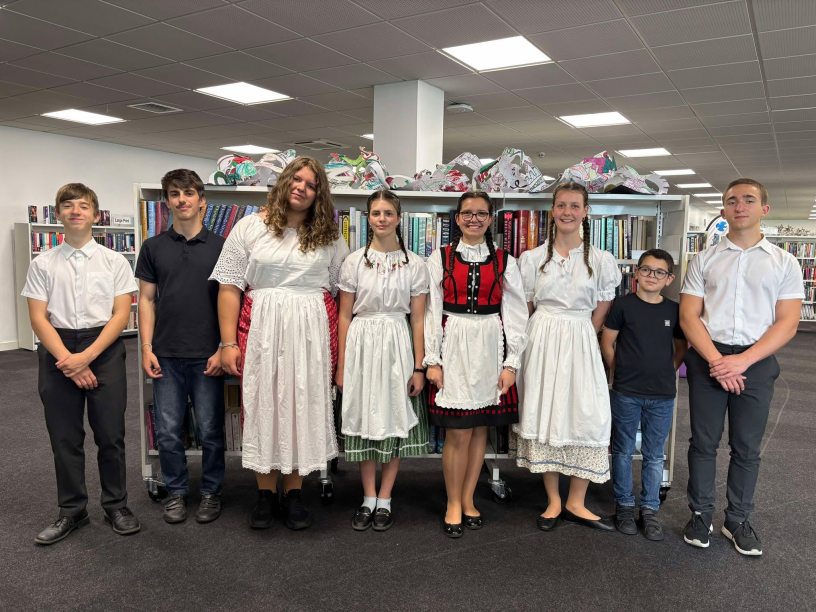
Tulipan Zither Band is made up of twenty-five young people, aged from five to 15.
Every Saturday, their families travel to Gorse Hill Studio in Old Trafford from all over Greater Manchester, with some coming from even further afield, including Chester, Preston, and Wakefield.
The group has come together to play and improve their skills on the unusual stringed instrument every Saturday afternoon since May 2022, now under the tutelage of Erika Kollár.
Erika, who herself has played the zither since she was a child in Slovakia, believes it to be the only zither orchestra in the country. Popular in Hungary, the country of her heritage, as well as in many parts of Asia, the Middle East, and across Eastern and Southern Europe, it is, however, an instrument little known in the UK.
Tulipan, which means tulip in Hungarian, began as part of The Dancehouse project for Hungarian diaspora young people, which also includes folk dance tuition and a Hungarian scouts group. It is delivered by Manchester-based creative youth and community organization Beat Bazaar, which also launched the free annual cultural festival Góbéfest in 2017.
Although every orchestra member is from a Hungarian cultural background, they have moved to the north of England from a number of neighboring countries including Romania, Slovakia, and Serbia.
The orchestra has previously played at Góbéfest in Manchester’s Cathedral Gardens, Manchester Central Library for International Mother Tongue Day, and at Chester Storyhouse for a Hungarian cultural celebration.
On Saturday 21 June, they will once again perform at Manchester’s free outdoor Góbéfest festival, opening Saturday’s program at 11.30 am.
The young people who make up the group play instruments of different sizes and pitches, including bass and alto zithers, but all have 16 strings. The zither is known as a citera in Hungarian.
Essentially a wooden “sound box,” with between one and 50 strings, what distinguishes the zither from other stringed instruments such as the guitar or violin is its lack of a slender ‘neck.’ Unusually, it is also played flat on a table, or sometimes on the lap, and the strings can be plucked directly with the fingers or using a plectrum. Its origins can be traced to China or Persia.
Erika Kollár said: “I love playing the zither because it represents my childhood and youth.
“When I play with the group, I feel an indescribable happiness in my heart. I am very proud of this fantastic group because I can see that they will all become better than me, and also I can see the same happiness in them that I felt as a child. I will keep feeding the musical fire I see within them all.”
Márton Lange, aged 15, from Leigh, who has been a member of the orchestra since the start, said: “I really enjoy learning the zither because I learn a lot of new songs that are part of my Hungarian heritage. It’s such a cool, unique instrument to play, and it’s certainly very unusual in the UK to be a zither player. It is not so well known here. It also feels good to continue in the footsteps of my ancestors, who were also musicians and played several instruments.”
Léna Ördög, aged six, from Salford, said: “I like playing the zither because I like the sounds that it makes, and I can play my favorite song on it, which is called ‘I caught a mosquito.'”
Catch Tulipan at Góbéfest on Saturday 21 June 2025
Discover more from
Subscribe to get the latest posts sent to your email.
 news4trafford.co.uk