
What does a star smell like? Can you stay on your feet during a moonquake? And what really happens when astronauts need the loo in space?
With less than a month until its new exhibition opens, the Science and Industry Museum is revealing some cosmic secrets visitors can expect when the world-premiere Horrible Science: Cosmic Chaos launches on 13 February.
Blasting off into the Solar System, the exhibition marks the first time the beloved Horrible Science brand has been transformed into a large-scale immersive experience. With hands-on experiments, interactive challenges, and mischievous storytelling, it promises a high-energy voyage through space and encounters with characters from the hit CBBC series, Horrible Science.
Launching first in Manchester this February before touring to the Science Museum in London from March 2027, it aims to be one of the UK’s standout family-friendly cultural experiences of 2026 and beyond.
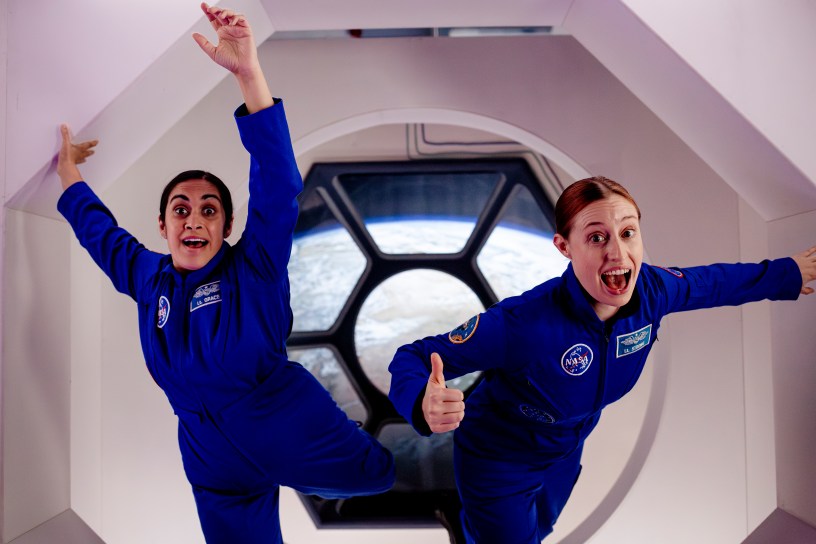
The adventure begins in the lair of evil genius Dr. Big Brain, who recruits visitors for a series of cosmic challenges as he plots total galactic domination. From there, space explorers are sucked through a wormhole and dropped into Awesome Astronauts, where life aboard the International Space Station is revealed.
Against stunning aerial images of Earth taken from space, visitors can discover how astronauts eat, sleep, work, and train their bodies to cope with weightlessness.
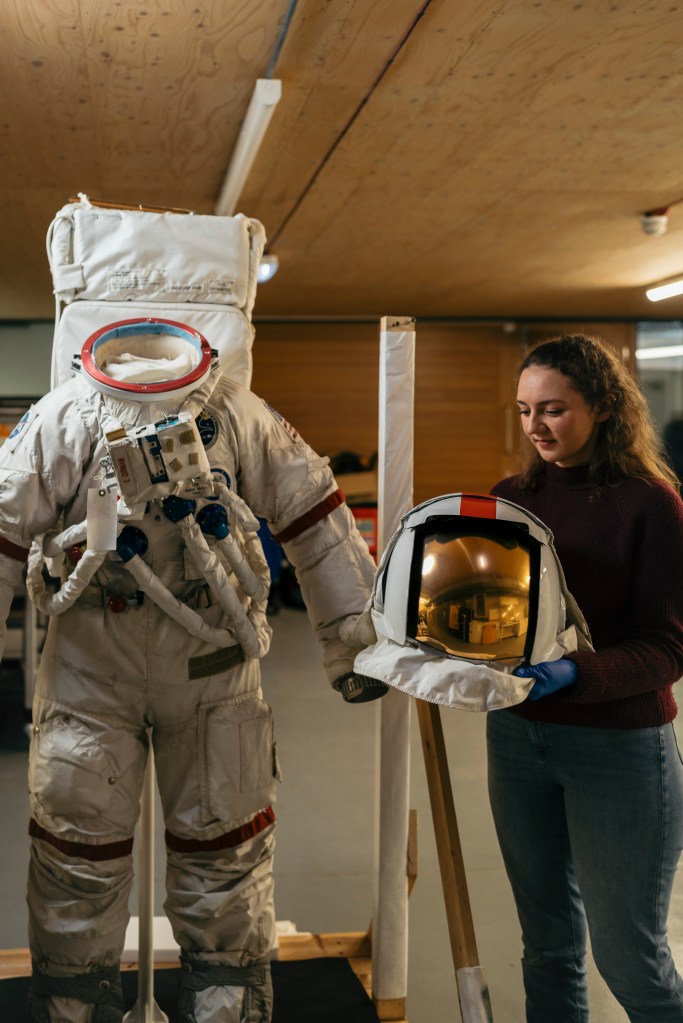
Rare star objects bring space life closer than ever, including Tim Peake’s headset from his 2015 mission, which is on display to the public for the first time, examples of real space food, and even a space toilet used by astronauts on the Soyuz-Mir spacecraft.
Stories of men and women who’ve lived in orbit help paint a picture of life beyond our atmosphere for curious earthlings.
Designed to engage all the senses, Horrible Science: Cosmic Chaos even lets visitors catch a whiff of smelly space socks (there are no washing machines in space), snap a selfie on a space toilet, and take part in a micro-gravity optical illusion where they appear to float.
Next stop: the Mysterious Moon. Here, visitors explore the only place beyond Earth ever visited by humans. Familiar faces will be on hand to guide space explorers, including the Moon character from the Horrible Science TV show, still grumpy that no one’s visited since 1972.
NASA mathematician Katherine Johnson, whose calculations of orbital mechanics have been fundamental in successfully launching spaceflights, will also help to navigate the Solar System.
Budding astronauts can dress the part and pose against dramatic lunar landscapes, touch a real piece of the Moon that fell to Earth as a meteorite, have a go at launching their own rockets, and see remarkable objects including flight plans from the Apollo 11 mission, bearing contributions from Katherine Johnson and signatures from the first Moon-landing crew.
Visitors can also test their balance during a moonquake, rummage through a giant space rubbish dump to feel what’s been left behind on missions, and even take a sniff of scientists’ best attempt at recreating the Moon’s dusty odour.
Things heat up in Sizzling Sun, a glowing zone dedicated to the star at the centre of our Solar System. Guided by Isaac Newton, visitors will grapple with gravity, solar storms, and eclipses, chase solar flares, and discover how stars are born and what they smell of.
From there, it’s time to zoom out in Weird Worlds and take in the full Solar System. Find out what makes a planet (and why Pluto lost its status), step inside Mercury, and choose whether to be chilled or warmed by its extreme temperature swings, and see how your strength compares across different planets under changing gravity.
Highlights include a life-size model of the Beagle 2, which was the first UK and European spacecraft to land on another planet, a chance to programme an interplanetary rover, and a replica of Galileo’s telescope, bringing the history of astronomy to life. Dr. Big Brain has also set an impossible quiz that visitors can attempt to conquer.
Space explorers can wind down on the sensory Planet Quark and enjoy a twinkling starscape in the Cosy Crater, before diving into Dreadful Deep Space where the most mysterious wonders from beyond the Kuiper belt are explored. This includes exoplanets and black holes, where visitors can try out the mind-bending phenomena of “spaghettification.”
The awe-inspiring scale of the science carried out by spacecraft will be highlighted in this section, with a life-size replica of the CHEOPS satellite on display, the original of which is still travelling through outer space in search of exoplanets. Visitors can even record messages and translate them into alien languages during a challenge set by Dr. Big Brain.
Finally, shake off the space dust by visiting an alien Disco Planet, where every day is a party. It’s here that the fate of Dr. Big Brain’s evil plans will be revealed, and visitors can release their own energy by dancing with the stars.
The exhibition is being developed by the Science and Industry Museum and created in collaboration with producers of the new Horrible Science TV show, BBC Children’s and Education, and Lion Television, an All3Media company, together with Scholastic, publishers of the much-loved Horrible Science book series by Nick Arnold and illustrated by Tony De Saulles, which celebrates its 30th anniversary this year.
Launching first in Manchester for an 11-month run before touring to the Science Museum in London from 18 March 2027 – 27 February 2028, it is set to be one of the UK’s standout family-friendly cultural experiences of 2026 and beyond.
The second series of Horrible Science is coming to CBBC and iPlayer in Spring this year, showcasing the finest home-grown comedic storytelling that brings families together with laughter and learning.
Tickets to see the exhibition at both museums are now available to book online. At the Science and Industry Museum, they are priced at £10, with family discounts available and under-threes going free.
The exhibition is being supported by Major Sponsor, CGI, one of the world’s largest independent technology and business consulting services firms, as part of their mission to inspire young people in STEM. A range of interactive and entertaining Horrible Science-inspired toys, games, kits, and experiments will be available to buy online and in the Science and Industry Museum shop.
The exhibition will be accompanied by an extensive programme of supporting events, including accessible sessions, British Sign Language tours, adult-only after-hours access, toddler-and-parent events, and space-inspired holiday programmes.
It is also guided by core objectives of the Key Stage 1 & 2 curriculum by offering early learners the opportunity to experience and observe phenomena of the world around them. Educational visits can be booked via Group Booking Portal.
Discover more from
Subscribe to get the latest posts sent to your email.
 news4trafford.co.uk